Showing posts with label Stitches. Show all posts

Wednesday, December 19, 2012

Stitches: Slip Stitch

Usually, slip stitches are used to join rounds or to add new yarn. Here's an idea of a way to work with slip stitches to create new textures.

Chain any number of chain stitches and work slip stitches into the chains. Chain one and turn. Working in the back loops only, work slip stitches across to complete row two. Continue working with routes of slip stitches in the back loops to create this pattern.

This creates a ribbed look that is similar to the look of knitted fabric. Because slip stitches have little height, this stitch is a little slow to work up, but the result is a flexible fabric.

Monday, December 17, 2012

Stitch Pattern: Cross Stitch

This stitch can be complicated when using a short stitch such as the single crochet or half double crochet. I find its easier to work this stitch using double crochet or taller stitches.

To start, you'll chain a multiple of two. When working your rows, skip one stitch and work in the next. Once that stitch is made, you'll work into the stitch you skipped. The next stitch will require you to skip the one you worked into and one more. (i.e. You'll skip two stitches total. One is worked into already.) 


When working this swatch up, I found it more pleasing to add an uncrosssed double crochet stitch on the end of each row. (The chain counts as the beginning double crochet stitch.) This helps keep the ends straighter. Ending a row with a crossed stitch will result in a wavy edge. This is just a matter of personal preference though, so try it both ways.

One of the things that I liked about this stitch is that the pattern creates almost a zigzag pattern as you work your rows. It also creates an interesting texture to the fabric that would be great for creating dishcloths when used with shorter stitches. It would be textured enough to provide a little scrubbing power. 

Friday, December 14, 2012

Stitch Pattern: Track Stitch

The track stitch is actually fairly simple to make. The result - a look that suggests someone ran over it... it makes tracks in the work, hence the name of the pattern.

To create this pattern crochet an uneven number of rows with single crochet. Then work a row of treble crochet stitches. Repeat this pattern throughout your work and you'll see the tracks. Finish with a row of single crochet stitches though so your work holds its shape.

Why does it matter that the number of rows worked in single crochet be uneven? This ensures that the right side of the treble crochet stitches is seen on the right side of your work. Here are a couple of pictures to show you what I mean.

The back of the treble crochet stitches looks like chains. The front is flatter and the two horizontal bars can be seen.

Saturday, November 17, 2012

Stitch pattern: post stitch ribs

Looking to add some texture to your crochet work? This stitch creates a fun ribbed look that's flexible and stretchy. I could easily see this pattern making some great wrist warmers or fingerless gloves or wristers. It would provide the stretchiness needed for the gloves to slide on but remain form fitting where needed.

To make this stitch pattern, you'll be working around the posts of double crochet stitches.
To start work a chain in a multiple of 5 stitches plus 10. Dc in 4th chain from the hook and in each ch across. (The 3 beginning chs count as a dc.)
Row 2: Ch 2 (counts as first hdc), fpdc around next two sts, bpdc around each of next two sts. [fpdc around next 3 sts, bpdc around next 2 sts] across. End with fpdc around next two sts and hdc in last st (the chains from previous row). Turn
Row 3: Ch 2, bpdc around next 2 sts, fpdc around next two sts, [bpdc around next 3 sts, fpdc around next 2 sts] across. End with bpdc around next 2 sts, hdc in last st (chains from previous row). Turn.
Repeat rows 2 and 3 for pattern.


When looking at your work, one side will have sets of two raised ridges, and the other will have sets of three raised ridges.
For a different effect: you can alternate each stitch. (fpdc, bpdc across. and the third row will be the opposite [i.e. bpdc, fpdc across].) This will create ridges that are closer together and alternate across your work.
What other patterns and possibilities can you think of for this stitch?


Saturday, October 6, 2012

Stitch Combination: Grit Stitch

Here is a stitch that is very similar to what some people know as the V stitch. Instead of using tall stitches like the V stitch, this stitch is created with two single crochet stitches in a stitch. Each group of two single crochet stitches are separated by a chain stitch.

To make this stitch begin by chaining a multiple of two stitches. Here's a chart to make this stitch.


 While this stitch might look dense, it is actually very flexible and lighter than single crochet stitches. This stitch combination could also be done with taller stitches (hdc, dc, tr or taller), but remember to modify your turning chain to accommodate the additional height.

Friday, October 5, 2012

Stitch Combination: Shallow Stitch

This is one stitch that will challenge those that like to crochet by the "rules." For the most part, crochet stitches are worked under the V (as you look at it from the top) and above the horizontal bar (when seen from the side). For the Shallow Stitch stitches are worked *under* that horizontal bar of each stitch.

Here is a look at what this stitch looks like.
 
This stitch creates very strong horizontal lines as it gathers the three strands from the previous row together. To make this stitch, chain any number of stitches but make your chain loosely to accommodate for the stitches worked in spaces. 
The image above shows the shallow stitch swatch next to a double crochet swatch. Notice that the shallow stitch has much cleaner (in my opinion) horizontal lines. With a bulkier yarn I think this might make for a fun scarf. 

Thursday, October 4, 2012

Stitch Combination: Seed Stitch

This stitch combination creates an interesting look with a little texture. This is similar to the open stitch combination, except that it uses single crochet stitches. I.e. It is created by alternating single crochet and chain stitches.
There is one major difference between the two combinations. In the open stitch combination, the double crochet stitches are worked into the previous row's double crochet stitches. In the seed stitch, single crochet stitches are worked in the previous row's chain stitches.

To make it, chain a multiple of two plus one.
One thing that I wasn't a fan of when trying this stitch out was that one side of the pattern creates a zig zagged edge. Perhaps a slip stitch at the end of row 2 (to attach it to row 1) in the pattern diagrm above would help solve this. 

This stitch could also be done by changing the single crochet stitch for a taller stitch, like the double or treble crochet stitches.
What are your thoughts about this stitch? Have you seen it used in any patterns you've worked on?


Stitch Combination: Open Stitch

 The open stitch pattern is similar to a mesh stitch. It results in a series of open boxes and a light density. This might make for a very pretty shawl or light scarf. To start, chain a multiple of two plus one. It's created by alternating between double crochet and chain stitches, and rows end with a double crochet.


Monday, October 1, 2012

Stitch Variations: Popcorn Stitch

Popcorn stitches all use the same process to create, regardless of what kind of basic stitch you're working with. They can be created with any stitch except the single crochet, but the double crochet stitch is most commonly used.


To create a popcorn stitch: work a group of 3 or more stitches, we'll say double crochet stitches for this example, into one stitch or space. Remove the hook from the working loop you've been using and insert it into the first double crochet in the group. Pull the working loop (that you dropped before) through where you now have your hook. Your popcorn should pop to the front. Secure it into place with a chain stitch.

Tip:  When working on the wrong side, you can insert your hook from the back to get your popcorn to pop to the correct side.

This technique creates a 3D effect and can be used to create numerous designs and patterns. In my photo, I made a diamond.

Thursday, September 27, 2012

Extended Stitches: Extended double crochet

To make an extended double crochet stitch: Yarn over once, insert hook, yarn over and draw a loop through one loop. Yarn over and draw through two loops. Yarn over and again draw through two loops.


This swatch of edc looks like a swatch of double crochet, but it's actually a step taller than the double crochet, making its height fit between the double and treble crochet stitches.


(From left to right) Double crochet, extended double crochet, and treble crochet.

Extended stitches could easily make a smoother line. (i.e. If you used the pattern of: sc, dsc, dc, edc, tr  you would have a smooth curve instead of a stepped or zig zag one.

Tuesday, September 25, 2012

Double treble crochet stitch

Here is a stitch that I don't think I have ever seen in a pattern. (Maybe I should use it in one.) The dtr or double treble crochet stitch is made like the treble crochet stitch but with an extra yarn over.
For example, the double crochet stitch needs one yarn over before inserting the hook into the stitch. The treble crochet stitch needs two. If you combine the two stitches (hence the name double treble), you need three yarn overs.
This stitch makes really tall rows and a lighter fabric with much more drape to it.


Swatch of dtr stitch


Single crochet stitch swatch next to the dtr swatch.


double crochet swatch next to the dtr.

Monday, September 24, 2012

Treble crochet stitch

The treble crochet stitch (tr) is one of the tallest stitches I have come across in patterns. There are taller ones, just add more yarn overs before pulling through your stitch, but this is the most common that I've seen. This stitch leaves you with an even more hole-y look than the double crochet stitch. It works up very quickly. 
The video for how to make this stitch is listed on the directory of stitches.


Treble crochet stitches

Double crochet stitches (left) next to treble crochet stitches,


From left to right: Single crochet, double single crochet, double crochet, treble crochet.


Friday, September 21, 2012

Double Crochet Stitch

The double crochet stitch, another basic crochet stitch, is great for when you want to work up a piece quickly because it adds more height (compared to the half double crochet stitch) to each row. It doesn't have the density the single crochet has, so it drapes much better. The stitches have a hole-y look to them. Here's a sample swatch.


Here we have a swatch of double crochet (the gold) next to the swatch of half double crochet stitches. Notice how the half double crochet swatch doesn't seem to have as much space between the stitches?
 

When designing your own crochet patterns, draping and density will be important factors when choosing the right stitch for the pattern.

To see how this stitch is made, watch the video on the crochet directory page.


Thursday, September 20, 2012

Half double crochet stitch

The half double crochet stitch is nice when you want the density of a single crochet, but you want a little height. This stitch works up a little faster than the single crochet stitch, but it doesn't leave you with the hole-y look like the double crochet stitch.

To make a half double crochet stitch: yarn over once before inserting hook. Insert hook, yarn over and draw one loop through. (You will have three loops on your hook.) Yarn over again and pull through all three loops.
Abreviation: hdc
Here we have a swatch of half double crochet. 

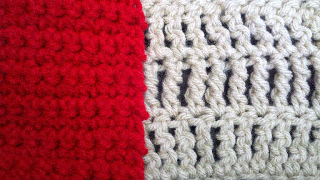
The red is a swatch of single crochet. Notice the size difference.

To learn how this stitch is made, watch the video on the directory of stitches page. 

Tuesday, September 18, 2012

Single crochet

Single crochet is probably the most basic stitch. The result, depending on the yarn or thread, is often a thicker fabric that doesn't have much give or ability to drape. Using a larger hook will result in a lighter fabric with more give to it.
The stitch is marked with an X on crochet charts, and in patterns its abbreviation is "sc."


Here's a link to a Crochet Geek video about how to make it.
Single Crochet Video